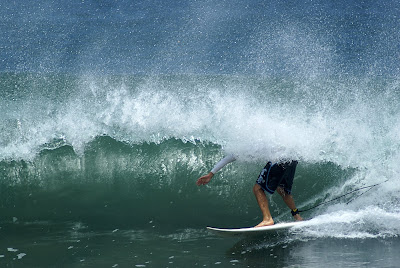
Friday, July 4, 2008
Tuesday, June 17, 2008
Tuesday, May 13, 2008
Gigante, Nicaragua
Ryan and Grey's House
The fishing village of Gigante supports around 40 fisherman and their families
My friend the white-face monkey who was a pet at one of the small village houses
One of the Gigante locals takes a curious look at my camera
The Giants Foot Peninsula that forms the south barrier of the village of Gigante
Heading out at Play Colorado two beaches north of Gigante
Just inside the barrel on a quick right
Should be higher on this backside drop, but im learning
Ryan, Davey, and Juancho all prepare for the pig roast feast
Dervis and I with the remains of the pig, some of the rest of him is on my plate
Tuesday, April 15, 2008
Tuesday, April 1, 2008
Leaving Peru for a Suprise Weekend In NYC
First, I have been accepted to the McCombs Business School MBA program at the University of Texas in Austin. I will be moving to Austin and starting school in early August.
Second, after Laura left Peru on March 16th I returned to Pico Alto Surf Camp (PASC) in Punta Hermosa to spend the week leading up to Semana Santa (Easter) surfing. The Semana Santa weekend is absolutely crazy, as everyone in Lima who can scrape together a few Soles and anything that can float, heads out into the water. I was able to surf a bit on Monday through Friday geting used to my new 6'4 Lost Speed Demon II surf board which I had purchased in Lima earlier that month. I caught great waves at the big breaks of Punta Rocas, Senoritas, and Caballeros and thoroughly appreciated the extra couple inches in length I went with in choosing my board. However, as the weekend arrived, some reef cuts and bad chest rashes from the board began to wear on me at the same time the waves got more crowded and difficult to compete for. I starteted to experience my first real surfing fatigue.
As crowds continued to swarm the beach, I was faced with being forced out of my room to accommodate previous PASC reservations. I made the decision to fly New York for Easter and my sisters birthday which were that weekend and which my parents had already traveled up for. I snuck onto a plane Friday the 21st without telling them and by Saturday morning showed up at their hotel room door as an unexpected Easter/Birthday surprise. It was an amazing week in New York seeing both my family, friends, and of course girlfriend Laura (who was equally surprised). Though it wasn't my original plan the month of March ended in a spate of much missed American luxuries: steaks at BLT Prime, sushi, a Rangers game at MSG, a matinee of Jersey Boys with the fam, and cocktails and the delicious 'devils on horseback' at SoHo hotspot Friedmans.
My time warp from the the third world to the big apple was such a whirlwind I scarcely had time to process or plan. I just knew my body was surf sore and that for the time being I felt OK about having my board lay dormant as I reacquainted with stateside life and made plans for the upcoming four months before school.

La Isla Beach experiences the crowds of Semana Santa
Monday, March 17, 2008
Villa Sirena and Los Organos Beach
This left Laura and I no option but to go forging into Mancora in search of sustenance. We found an 'Italian' place with an outdoor seating area that appeared to be Mancora's most tourist friendly establishment. As we begin to dig into our pizza and bottle of white wine, we quickly became aware that the good food and tropical ambiance was also appreciated by a thriving population of cockroach/beetle like creatures who dropped down on us from the trees above and scampered about over and between our feet. Like any good tourist adjusting to new surroundings we turned to the bottle, quickly killing the wine, then heading to the Lone Star bar down the street to finish of the night with shots. Ironically, the tequila and kolua mixers we selected as our shot of choice were called La Cucarachas. We made it back to our 'luxury' bungalow at around midnight where we gladly collapsed on the bed/mattress, the lone piece of furniture adorning the cement floor.
The next morning, through groggy eyes, we awakened to a gorgeous sunny day and a pristine view of our own private pacific beach. Chairs were lain out by the pool just inviting us to head over there, settle in with a book or a crossword, and order that first 8:30 AM cocktail. Well, we had made it just about to steps beyond our porch when the first swarm of sand gnats hit us. Within seconds they were crawling in our eyes, nose, and teaming inside my numerous surf cuts. Like any rational people trying to enjoy a vacation, Laura and I both intuitively transitioned into a policy of full strategic denial. After 6 minutes of trying to sunbathe/read/order breakfast while simultaneously serving as an insect sanctuary all such pretense evaporated in the face rapidly encroaching insanity. We sprinted back to our room/cell and mentally prepared ourselves for a tropical weekend spent hiding from the flies in a steaming hot cement bungalow.
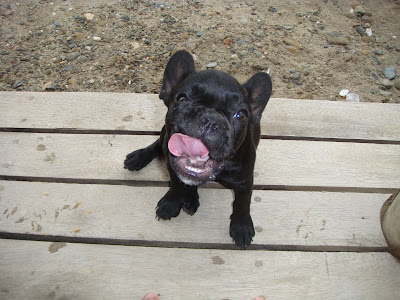
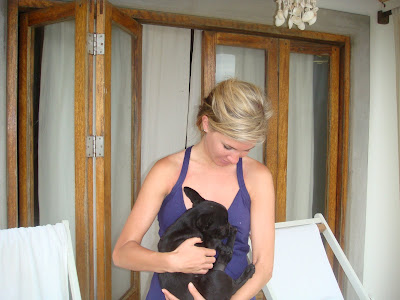
The good part of this story is how it ends. The wind picked up within an hour and all the sand gnats disappeared. We ended up really enjoying the beach, the hotel and its staff grew on us, and at $25 per person a night we felt like we actually had found a pretty good deal. Its pretty tough to find a private beach in that range here in the states. Oh, and also we may have become slightly obsessed with one of our fellow Villa Sirena residents, who was about 2 months old, black, and named Moonie.
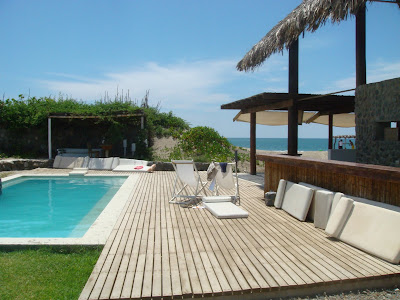
Heres the view from our porch of the Villa Sirena pool and the ocean beyond
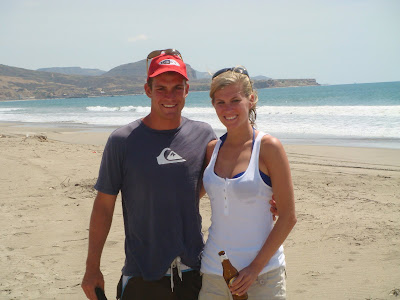
Laura and I enjoying the beach
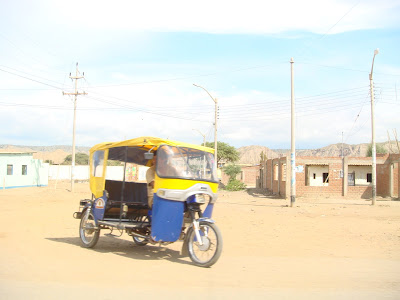
Our neighborhood taxi
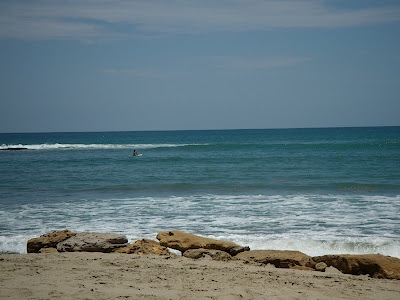
Thats me surfing . . .errr floating in the waveless expanse that was Organos Beach
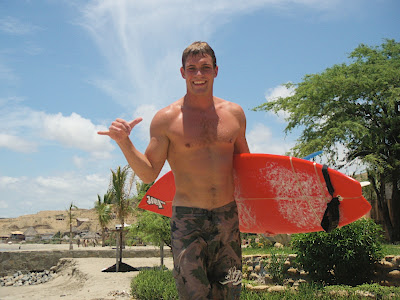
Even if I didn't catch any big waves to show off for Laura, I can always impress her with my super cool surfer pose
. . . and then Laura left me for a dog and its name was Moonie
Whats more fun the a Peruvian French Bulldog !
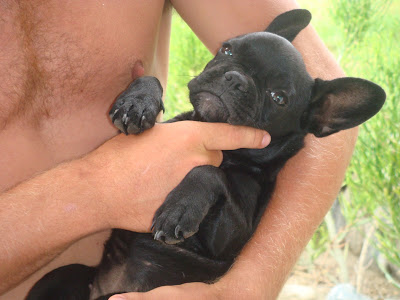
Not quite Hercules but pretty cute
Wednesday, March 12, 2008
Machu Picchu with Laura
Without further ado, some pictures . . .
This rat looking creature is called a Cuy and is and Incan delicacy. I was kind of grossed out, but Laura just couldn't get enough .
On of the two giant Spanish cathedrals in the main square in Cuzco
Laura and I, dry and all smiles, right before the start of the Inca trail trek
Notice the small size of our backpacks in the previous picture, its because the above army of porters were shlepping all our gear. They all lived near to Machu Picchu and spoke Quechua a language derived from the Incans.
Laura told me she wasn´t going to leave Peru without seeing a llama; unfortunately this herd came cruising across path our second day on the trail
These ruins (much of which are actually rebuilt) are in WinyaWinna the last Incan ruin site before Machu Picchu. The terraces you see were for growing crops while the house like structures provide shelter to Incan pilgrams on there way to Machu Picchu.
Laura is inside one of the Incan ritual baths, you can see these square structures stair step down and water would flow down through all of them so the Incans could cleanse themselves prior to arriving at Machu Picchu. When we were there, however, there was not so much water flowing but there was beer as evidenced by those rouge bottles that made the shot.
This shot from WinyaWinna shows the amazing Incan stonework. Each stone was split, cut, and smoothed to precise specifications to fit exactly with other stones so that all the construction would be motor free. These structures are amazingly strong and have survived numerous earthquakes.
Trying to sneak up on a llama and looking a little sheepish
The classic view of Machu Picchu as you approach along the Incan trail below the Sun Gate. We had about a 10 minute window from the clouds and were lucky enough to snap a few photos.
A shot of the two conquistadors after concurring the trail.
Friday, March 7, 2008
Pico Alto Surf Camp, Peru
I stayed at PASC for 8 nights at a whopping 25 dollars per night which included 3 meals a day. I also had my own private room with a TV, a DVD player, and a computer with internet across the hall. We were served home made lunches with rice, marinated meats, and great spicy sauses. It was amazing, especially after a full morning of surfing the cold waters and strong currents that I found ever present in Peruvian surfing. It was a big adjusment from my Costa Rican experience. The surf was just much bigger, with longer paddel outs, more current, and less clean waves where positioning and take off points were not so obvious to me. Peru is a bit of a rough and tumble surfing world. You are paddeling out, pushing trash out of your way as you go, and taking in the dusty desert skyline and hazy outline of nearby Lima. However, when you do finaly get in on one of Peru's big rolling waves, the ride is so much longer then those in Costa Rica, you remember why people come from all over to surf here.
Views of Senoritas and Caballeros, the two breaks I surfed the most
Some of the Brazilians prepare for a surf session
A view of a break called Puerto Viejo south of Punta Hermosa and Lima
'Me and my surf buddy Alex, who was nicknamed Cachito which means a bit or a morsel
Oscar Jr. , the Godfather of Punta Hermosa and one of the nicest guys I met while traveling
Me with two of the night club promoters of Hapas which was the big weekend discoteca in Punta Hermosa
Wednesday, February 27, 2008
A Train, a Bus, and Buenos Aires
In Viedma we caught another 12 hour bus to Buenos Aires. In BA we checked out the graveyard of Eva Peron, ate at some Parillas, and went to some bars and night clubs. It was a fun time. A few pictures are below . . . now off to Peru.
The old train we took from Bariloche in the Patagonia to Viedma on the Atlantic Coast
Sean and James make eyes at each other in the train dining car
Trying out my artistic black and whites at the Buenos Aires graveyard with Eva Peron's grave
The view down the street our hostel was on in B.A.
Tuesday, February 19, 2008
Climbing Mount Tronador
It ended up being all we could handle. On the first day we hiked up to a refugio, a mountain hut, at the base of the huge glacier that covers Tronador. We ended up forming a summit team there with a very nice couple who were park rangers at Yosemite in the US. The five of us started at 5 in the morning and traversed across the glacier in rope teams until around 10 when we reached the saddle between the two peaks. The glacier was gorgeous and we saw some huge crevasses to remind us why we were tied into ropes.
The only technical part came during the last 20 meters of climbing. Here is was a nearly vertical wall of loose rock and ice mixed together. Not great climbing conditions. A guide who was taking up a client that day turned around in front of us unwilling to take the risk. Chris, the husband in the park ranger two-some we had linked up with, was willing to lead this section of this climb and set up some protection by using some ice screws. We were all able to make the climb without falling but the shear exposure was terrifying, ice screws or no ice screws protecting us.
We all peaked out, repelled down the ice/rock pitch, and then traversed the glacier back home. It was an amazing climb, an a totally unique experience to be surrounded by such an alien landscape as a glacier. I was super lucky to have a great group of friends willing to take me.
A view of Pico Argentina, front right, from the glacier below
Climbing up to the saddle between the two peaks
Chris leads the way climbing the last vertical pitch
James and I celebrate on the summit
The beginning of the repel down from the summit
Some steep snow, but so much easier coming down
Crampons help, but you don't wont to slip . . . the drop off is pretty sheer to the right
A last stop on the snow before reaching the refugio
Let me introduce you to the staff which had a hot meal waiting for us back at the refugio.
Friday, February 1, 2008
Spanish School Bariloche, Argentina
First to orient you guys check out the map below of Argentina, where you will find Bariloche in the southwest in the Lake District of the Patagonia along the border with Chile.
Looking down from the Cerro Otto hill to the town of Bariloche and the giant Lake Naheul Huapi
I spent the first three weeks attending Spanish class 8:30 to 12:30 Monday through Friday at the A.I.E Patagonia Spanish language school. For those of you wanting to improve and live in an awesome place check out the school at http://www.patagoniaspanish.com/. Class for the first week was one-on-one and for the second two weeks there was only one other student.
Learning Spanish with my teacher Carina
While I was in class I was living with a family. My Senora was an incredibly nice woman who has one grown son and two beautiful grandkids. Her granddaughter Delfina was always at the house and was a wonderful three year old playmate and Spanish teacher for me. We were fond of watching Discovery Kids in Spanish together, with our favorite program being Backyardagins. I had my own room in Teresa's house, got a homemade dinner every night, and even got to join in on a festive asado (BBQ) at the lake side house of a family friend of Teresa's.
Delifna rolls her father down the hill at the asado while Teresa looks on at her son and grandchild at play.
During the weekends Bariloche offered tons of opportunites for play. We had a great core group of students that got along really well. There were my two mountaineer buddies from Colorado, James and Sean, and the adventurous Allesandra from Italy. The four of us did lots of activities together including trekking between Mountain huts, rockclimbing, relaxing at the many lake beaches and even wakeboarding.
The whole crew of Sean, James, Alessandra, and Me before our two night three day trek through the mountain refugios (huts) of Bariloche
The view from Refugio Frey looking out at the Cathedral Spire
James, Sean and I before hiking down from Lake Jacob
Working my way up the rockwall
Sean and I pose with our wakeboarding local friends German and Mario
A glimpse of relaxing on the beach of Lake Nahuel Huapi
Sunday, January 27, 2008
Six Days in Santiago, Chile
I am staying with Jane Hong. Jane and I, besides being connected through my sister, have also shared parts of both high school and college together- so she knows me pretty well. She also knows the city after 6 months there and has an amazingly comfortable couch, so I was perfectly content for my six day sleepover.
I explored some of the local city neighborhoods-barrios- during the day while Jane was at work. One day I tracked down the famous Casa Roja hostel that had been started in a an old run down mansion. I snuck in to read my book by the swimming pool hidden in the spacious open air quadrangle behind the house.
I spent that gorgeous afternoon finishing War and Peace, which I had been working at assiduously throughout Costa Rica. At first I had struggled to find the connection between early 19th century tsarist Russia and traveling in tropical surf hostels, but eventually Tolstoy’s universal relevance won me over. By the end, I felt no other book could have possibly been more relevant to my current time and place. Tolstoy gets to the heart of what we seek in life and explores our often unarticulated conceptions of happiness, purpose, duty, and hope.
Jane and I had a great time during our week. We ate out every night and had a great time bonding over delicious, though certainly American priced, food. We also had two nights out one the town. The first, we were joined by my former Princeton OA compatriot Alisha ‘the wizared . Though we went to a dance club in search of 80s music, we ended up primarily finding extremely strong Piscolas, local grape liquor mixed with coke, that had us staggering for a cab well before the dance floor hit its groove. The second night Jane and I flew solo to a jazz club and made up for lost time listening to covers of Bary White, Elvis, and that song from Ghost. We were the butt end of many of the crooners jokes which somehow made us popular with the local Chilean crowed and led to late night dancing and a generally good time.
Santiago seemed a very modern city. The are of Los Condes where Jane lived is the financial center and is dotted with skyscrapers and bankers in suits walking in between. It really seemed not to much unlike NYC. Since I am just getting my feet wet on the South American experience, Santiago made a good place to start
View of the pool in hostel Casa Rojo
Looking down a main street in Los Condes
A chilean BMX biker in a bark in Barrio Brasil
Out on the porch with the Wizard at Janes
Jane and me out at the bars
Dinner at a Chilean Italian place, I of course was wearing my one outfit which I purchased there to augment the wordrobe of boardshorts and t-shirts i had brought from Costa Rica
Wednesday, January 16, 2008
Puerto Viejo and Goodbye Central America
My final two days in Central America were spent in San Jose at the Tranquillo hostel. Here we linked up with our friend Jason from Bocas and continued the theme of lazy days and late nights. We watched the NFL playoffs and gambled at the infamous Del Rey Casino, drank cocktails poolside at the Mariott- thanks Jason's grandparents- and even spent one night attempting to penetrate the San Jose dance club scene. At the advice of our buddy Kenny, a Norwegian surfer, we were told to blow air out of our lips with a 'ssssssssing' sound to attract the local chicas. Needless to say we were lucky to escape with our lives.

Ryan, Lawrence, Tim, and I in a pool grudge match at Rocking Js
Tim and I reminiscing about our previous travels
This picture only cost me 3,000 colones
Kenny, Liz, Ryan, Vicky, Me, and Jason all enjoying the Mariott
Sunday, January 6, 2008
Aqua Lounge Bocas del Toro
I rang in the start of my solo travels and the first week of 2008 in Bocas del Toro, Panama. Added to the week I spent there with my sister, my stay was 17 days.
The Bocas Archipelago has five main islands, but I spent the majority of my time on Isla Colon, which has the biggest town, and on Carineros, which is where my hostel and the surf break were. While Carineros is very small and has limited food options, you can take a water taxi to Colon and be in town in under a minute. Two Brazilians and I swam across one morning to provide some entertainment- i.e. something to gamble on- and won 30 dollars by making it in under 4 minutes.
The hostel on Carineros was called Aqua Lounge. It is one of those amazing yet simple ideas dreamed of by young people everywhere that usually go to die when explained to ones lawyer and insurance agent. Luckily things are not so in Panama. Aqua Lounge is a genius combination bar and hostel right on the water, that sleeps 22 people, and sells dollar beers and shots right next to an eight foot diving board going off the roof into the Caribbean. There are hammocks, a BBq, a deck for partying and porch for hammocks, and even a huge water trampoline for laying out. Everyone parties to Spanish Reggae music and slips and slides around the crowded dance floor/deck during the day. I mostly surfed, but it was amusing to come back to the hostel and find 60 Panamanian revelers grinding on your front porch.
There was a core group of foreigners who weathered the Panama City invasion over New Years, and we did our own fair share of partying and often ended up mixing it up Reggae style with the locals.
I hit the waves with most often with two buddies; Ryan, a San Diego State grad, and Guillerme, a Brazilian surf event organizer. You always took a boat to surf so it was much more fun and economical to head out with a friend. We surfed a reef point break that generated quick, sometimes barreling lefts. It was not the easiest wave, my feet got cut on the reef, but it forced me to work on getting down the line faster on my backside.
Some highlights from the 10 days at Aqua Lounge
10. Playing poker and blackjack with a pack of Portuguese gamblers who reminded me of gypsies
9. Watching Jason, the lounges longest staying guest, try to take a live kitten to bed with him after his completion of the 23 bar challenge
8. Ripping gainers off the roof diving board into the Caribbean
7. Grilling fresh fish on the BBq speared by our Brazilian friends
6. Racing the Brazilians in the much gambled on inter-island swim
5. New Years Eve: shooting vodka at the lounge, watching the fireworks in town from the bar, and promising to speak only in Spanish all night
4. Roberto who folds your boxers and makes your bed; not bad for a hostel
3. Jumping off the top deck of the party boat and swimming home after realizing we were the only partygoers on it
2. Tanya, the Iguana bartender, who looks like a Victoria Secrets model but take waves like Kelly Slater
1. Aqua Lounge’s free breakfast of pancakes, bread, butter, cheese, coffee, sugar, jam, milk, and chocolate sauce.
My home for ten days
The dorms, my bunk is the top left
Aqua Lounge owner Christian and bar tenders Andrea and Fabio
The Brazilian spear fishermen enjoy their feast . . .
. . . and the gypys Portuguese scavenge the leftovers
Party on the deck
Our new years party crew
Bocas seemed like a great place to be young; like camp
Ryan, Guillerme, and I watching surf videos
Guillerme and I about to jump in for some surf; luckily the water is warmer than the rain
Surfing my backside on a characteristic left
Friday, December 28, 2007
Christmas in Panama
Unfortunately, it poured rain the first five days Laura and I were here. I could still surf but it meant Laura got a little bit of cabin fever at the hotel. She made the decision to head back to Houston after Christmas to enroll in school to get started fulfilling some nursing school prerequisite classes. It is amazing that we have now done almost 5 months of brother/sister traveling together.
It poured rained on Christmas and Laura and I watched the rain dump through the stained glass windows at a small catholic church where we went to a morning service. Since the services was all in Spanish, I found myself watching the rain a lot. The last two days we got sun and toured over all the islands on motorcycles and then on a chartered boat. We got to snorkel on some remote island reefs and had a whole mile long beach break to surf ourselves. With the weather looking better and some good swell coming, I am going to stay on for at least another week.

Map of Bocas- we are in Bocas town on Isla Colon
Laura painted our Carribean Christmas Card
Solitude on the beach
The main street of Bocas town
Little houses with big christmas spirit
Taking the little boat taxis between islands
Javier our boat driver and some of his buds
Bocas waterfront
Laura on our wet motercycle tour
Monday, December 24, 2007
Costa Rica Retrospective: Travel and Ticos
Accommodations: You will spend between $12 and $30 per night on your hotel room. At the $12 end are the hostels, where you are usually just offered a dorm style bed with a shared bathroom. However, some of these are really nice and also have large front porches, hammocks, internet rooms, common areas with pool tables and TVs, and a cooking area. You also get to meet and hang out with tons of other travelers, so they are great places for doing all those things that young people tend to do when congregated in mass. You also meet tons of foreigners who are there to surf and party. We have hung out and traveled with French, Dutch, Israeli, German, Italian, South African, and Kiwis along the way. It helps that the lingua franca of these hostels, even in

Tranquilo backpackers hostel in Mal Pais where we stayed 9 nights.
The other accommodation option is a private room at one of the local hotels, or ‘cabinas’ as they are usually referred to. A two bed, double occupancy room will range from $30 to $60 depending on how close it is to the beach and whether it has AC, a refrigerator, hot water, or other ‘high end’ amenities. At the low end you will become accustomed to plywood beds, thin ‘

Cabinas Paulina in Playa Negra where Albero and Grady worked
Meals: My general rule of thumb is $7 for breakfast, $10 for lunch, and $15 for dinner, meaning that you spend more than 30 bucks per day if you eat all your meals out and are a huge eater like me. The typical local restaurant is called a ‘soda’ and consists of a little open air dining room with perhaps four tables and a colorful sign out front advertising the logo of local beer on top and the name of the ‘soda’ below. For instance in Matapalo we always ate at the soda
Breakfast always consists of the typical two fried eggs with a delicious fried rice and bean side called gallo pinto. This will usually only run you three bucks, but add a banana smoothie and some coffee- which they charge for refills- and you quickly hit six bucks. There is also always a 10 percent service charge and a 10 percent tax on all meals. Lunch offers the staple Costa Rican meal known as ‘casada’ or married; implying its what you will be offered every day of your life by your wife once you get hitched. A casada comes with rice, beans, a salad, a banana, and either a small filet of chicken or fish. You can expect to pay between 5 and 7 bucks for this, but add in a couple $1.50 cokes, a $2 ice cream desert, or an extra $3 fruit plate and with tax your quickly at 10.
Dinner, with the staple and cheapest option again being the cosadas, usually costs between 7 and 10 bucks. Poorly prepared American favorites like burgers, pastas, and burritos usually are on the high end and are very mediocre. In general it is best to stay away from meat dishes- very gamey- in general and stick to the seafood which is usually really good. A ceviche appetizer usually will only cost you about 4 bucks and is well worth all the fresh mahi mahi you get. On the booze end it is generally cheaper to drink beers which always hover in the $1.50 to $2.50 range- a six pack of the local beer Imperial is 7.50 . The locals don’t really drink cocktails, so the prices are exclusively for tourists and you will pay up to $5 for mixed drinks. Thus totaled you are spending 30 bucks a day just feeding yourself, not including that all important night out of drinking.
The other option, when your place has a kitchen, is to cook for yourself and buy groceries at the little local stores called Mini-supers. They carry the basic staples, some fruits and local vegetables, and have a small refrigerated section with some ghetto meats, cheese, and milk. The groceries are expensive though when only cooking for only 1 or 2 and so we ended up using these markets primarily to buy delicious ice cream cookie sandwiches called Trits which cost a dollar. Anyway, unless you are staying for an extended time at one cabin, there is no excess time or energy to cook between surfing sessions and traveling.
A ritual daily TritCost summary:If you could average 20 per night for your room and 30 per day for your dining out you would be traveling efficiently and still dropping 50 per day, or 350 per week, or $1,400 per month before any in country travel costs. Again the bus is cheap and is goes most places, but the car certainly makes it nicer if you can swing it. So
Tico 101: So the anthropologists among you may be wondering where the actual local population fits into this traveling business. Is there any interaction with actual Costa Rican’s (Ticos), or is it just a bunch of foreigners hanging out in a tropical surfing playland ?
The Tico population is only about 4 million, less then the population of greater
With half the population living around
Prior to the phenomenal tourist boom of the past 15 years, the Tico’s living along
The other change is that rather than working in agricultural related occupations, most of the Ticos work in something related to tourism. Boat captains, hotel cleaners, restaurant employees, souvenir craftsmen, and even security guards who watch the parked cars at surf beaches are all coveted jobs that Ticos have adapted to. Beneath these more conventional occupations is another layer cashing in on the tourism boom comprised of scammers acting as ‘independent tour guides’ and dealers peddling drugs or prostitutes.
Beneath this broad framework of tourist/service related jobs, it is often difficult to figure out exactly what, if any, specific job or employment some of the Ticos have. At every ‘cabinas’, restaurant, or local business there is at least one Tico, usually older, who seems to just be hanging around, not as a real employee, but usually as relative of someone actually working. They kind of sit around, perform an odd task now and again, and then sleep there way through the rest of the day in shady chairs. I interpret this as something like the Tico version of retirement.
The poster boy for this form of Tico retirement was a man named Albero who was a permanent fixture at the Cabinas Paulina where we were staying in Playa Negra. Jovial, paunch bellied, and never wearing a shirt, this 48 year old nephew of the proprietress Paullina spent 90 percent of his day sitting on the porch outside the dining area of the cabinas. He always greeted us with a hug smile and a genuine spiel on how he was there to help us with whatever we needed. Unfortunately however, whenever we asked him for a beer or something we were out of luck, as the key to Paulin’s beer cooler was apparently not a responsibility with which Albero was entrusted. When she was around he could go back and grab beers for us, but chiefly he just dosed in his chair or watched us play pool. He did have his great moment though. When the wall tiles of our shower collapsed and shattered all over our bathroom floor, I appealed to Albero to take care of the resulting pile of ceramic fragments. Two days later our bathroom was clean, so some proof does exist that he may have had an occupational function other than observing from his chair.
Beneath and behind all the tourist related businesses and services, however, much of Tico life in these coastal town goes on as it did before the boom. I was surprised to find that often, while despite making friendly efforts to be helpful, locals sometimes did not know the answer when asked where the nearest surf shop, gas station, or even road to a nearby town was. It seems many Ticos know their niche of the gringo world and don’t involve themselves with the rest, even if it exists right under their nose. What use has an old lady without a car for a gasoline station or a surfshop. There lives remain focused on family, the community, and making their living and they don’t bother with the gringo stuff. There are certainly many exceptions, among the young especially, some who have taken up surfing and have a firm grasp of American lingo and culture.
Finally, as always there are shades of grey, there are certainly Ticos who have much broader awareness of the world around them but continue to work within their local communities. For every Albero, loveable but provincial and hapless, there is someone like his nephew Grady who worked at the same family cabinas. Grady spoke English, worked cooking and managing guests at the hotel, and was also going to school three days a week for automobile maintenance. He is an example of an upwardly mobile and aware class of young Tico’s that exists in the provincial ‘surfing’ villages that is not dependent on American or tourist culture for identity.
Saturday, December 22, 2007
Four Seasons with the Family
. . . then enjoying some lunch
Will enjoys some spear fishing . . .
. . . then some golf
Mom and Dad watching me surf at Playa Grande during our one off Four Seasons excursion

Dinner on the last night with the Koehler's who were staying right next two us, forming a Houston posse
The parents left on the 19th to return to
Laura got one picture at Ollies before the camera went dead

The famous Witches Rock
Looking a little disoriented post day of surfing
Wednesday, December 19, 2007
The Nicoya Peninsula

The main map of Costa Rica to help you find the Nicoya Peninsula
Stop 1 Tranquilo Backpackers Lodge in Mal Pais- 10 days
Jumped off a forty foot waterfall in a nearby town called Montezuma. Got cocky after not killing myself and tried it again with my waterproof camera’s video running. Collision with the water jars camera from hand, camera sinks, suffice it to say there are no photos of the Nicoya from this point on.
Surfed in double overhead surfed at Playa Carmen that I thought was going to kill me. It was a gut check, boards were breaking. It took about 30 minutes just to paddle out.
Tranquilo Backpackers Lodge offered an amazing cast of traveling internationals. Including dude in his 30s from
Hanging out with our traveling buddy Tim from
If you are traveling here make sure to hit up all the surf beaches in the area. We used the car to the full extent, often loaded up with other surfers, and hit up Playa Carmen, Mar Azul, Ballyanath, Santa Teresa, Cabuya and Hermosa
Tim our traveling budy from Holland-photo courtesy of facebook-
Tim The waterfall I jumped and lost my camera
Stop 2 Blow Dogs Surf Camp in Nasara- 3 days
This was a four hour drive from Mal Pais through the interior of the
In Nasara we stayed at a ‘surf camp’ called Blow Dogs, which sounded cool, but unfortunately had just changed ownership the month before and become the Kaya Sol yoga retreat. We stayed anyway. Good beet burgers and good waves at nearby Playa Guiones.
Stop 3 Budda Bar in San Juanillo- 1 day
Used this as a jumping off point to surf Marbella, which is an amazing, uncrowded, surf beach reputed as one of Costa Rica’s best ‘secret spots’. Apparently it wasn’t secret enough as our car got broken into and two Ipods, two pairs of sunglasses, and my bankcard were stolen. On the positive side the waves were really good.
Stop 4 Cabinas Paullina 5 nights
This was the hotel where Albero and Grady (described in the entry above) worked. Also where we surfed Playa Negra and Avellanas where all the surf photos were taken(see the previous entry). These were some of the best waves I have had.
This was the final stop of our travels with Tim, the Hollander, who we left in Tamarindo on our way up to meet the parents at the Four Seasons
Wednesday, December 12, 2007
Surf Photos Avallanas Beach
Taking off on a left which is my backside
Looking to work my way back up the wave face
Working to hang on to the takeoff of this building wave
Feeling the wave chasing . . .
. . . and trying to escape before this overhead wave breaks
Taking a turn off the lip, not quite Kelly Slater crispness
Another right overhead
This is when surfing is fun
One wave peters out as swell builds behind me
Cruising in after the session
Monday, November 26, 2007
Traveling Costa Rica's Central Coast
Christophe and I had become pretty good friends out in the surf lineup and later spending time hanging out at his little beach camp. His camp was the paradigm of outdoor camping efficiency. To survive the rainy season in a tent in the Costa Rican rainforest, you have to know exactly what your doing. Christophe did. He had his tent underneath a large tarp which extended six feet beyond his tent door; giving him a dry open-air living space in which to cook and relax outside, even on rainy days. In this area he had one small chair, a makeshift wooden shelf for cooking, and a hammock attached between the tree at the front of his abode and his main tarp pole. It was cozy, clean, and you could see the surf from his “front porch”.
Things must have gotten a bit lonely out there solo for months, but Christophe always found entertainment in nature. When he did get human visitors he would talk about the animal adventures which he witnessed, like the time two crabs-both in need of a shell- fought each other over his toothpaste cap. Frenchman or not, Chris was fun, easy going, an experienced traveler and outdoorsmen, and we were happy he was joining us for the drive north.
On Thursday November 8th, four days before Laura, Chris and I were planning to leave I got really sick. That night I had a nice surf, we cooked out beef tenderloin with Andy and Terry, and all of us had a few beers during the evening. I started to feel ill and during the night I came crashing down with some sort of terrible fever. Full on teeth rattling shivers, body ache, and weakness followed by burning fever, soaking sweat, and general delirium. That first night felt like it lasted a week. Unfortunately the sickness was just beginning. I stayed in a state of high fever for the next two days, soaking through all my clothes with sour sweat and devouring ibuprofen to try to alleviate my vice like body ache. On Sunday, however, I felt a little better and assumed my sickness was not Dingy fever, as I feared, but instead a simple but painful three day flu virus.
Boy was I ever wrong. That day I made the mistake of going into Puerto Jimenez with Andy and Mike and having some beers while watching NFL games over the satellite. It was a good time, I guess, but I started to get nervous about a relapse when I felt my fever creeping back during the second half of the afternoon game. By the time I got home it was full on raging again. The fever from hell had started again and would last another three days.
We left Matapalo on Monday as we planned, despite my relapse, and Chris took the wheel while I shivered in the tropical heat in the passenger seat. That day we went only as far as Jimenez because I needed to take the ferry from there to the town of Gulfito the following morning to get tested for Dingy fever at a clinic. The ferry ride was interesting. Weakened by another feverish nights ‘sleep’, I passed out twice on the crowded boat. The only thing I remember is an old Tico attempting to revive me by shoving cotton balls soaked in rubbing alcohol in my nose. After coming to, I eventually did make it to the clinic and get the test that confirmed my low blood platelet level count was consistent with dingy. On the way back I missed the ferry to Jimenez by five minutes and was faced with the proposition of spending an hour and a half at the disgusting Gulfito port waiting for the next ride. Far too fatigued to even contemplate this boring proposition, I abandoned all financial restraint and hired my own private water taxi which took me and a boatload of lucky Ticans- who had also missed the ferry- back to Jimenez.
There is really nothing you can do to cure dingy fever. You simply rest, hydrate, try and control the fever through aspirin, and let the virus run its course. Over the next four or five days, I alternated between periods of relative strength and total fever delirium. During this time we made progress heading north. Once off the Osa Peninsula we made our first stop in the town of Ojochotal, which is just south of Dominical. We choose this area because the friendly ex-pat Steve, who we had met at the bar in San Jose, had encouraged us to visit him there.
Unfortunately I wasn’t to much fun at the time and Steve was about to leave for San Jose on business. This two day stop ended up consisting mostly of Laura, Chris, and I looking out from our hotel room porch to a view of the Pacific and talking the philosophical nonsense that foreign travelers always seem drawn to when thrown together. These sort of conversations always seemed to accompany Christophe’s nimble rolling of one of his signature splifs, which became a staple of the dingy recovery.
Our next stop was the picturesque beach and tourist friendly restaurants of Manuel Antonio, where we stayed for three nights. We found at room for only 30 dollars a night that was just a two minute walk to the beach. After the rest in Ojochotal, I began feeling well enough to surf the small break. Laura enjoyed walking on the long beach. The surf was so small through that Christophe left a day ahead of us and headed to Playa Hermosa, just south of Jaco. Laura and I spent extra day eating out and exploring Manuel Antonio national park, where we hiked through some forest trails and got to see a sloth and an albino agouti. We joined Chris the next day for the final section of our trip up the central coast in the town of Jaco and the adjoining Playa Hermosa.
Jaco is the closest beach town to San Jose and has some of the most consistent surf in the country. It was a shock the first day to paddle out and see fifty other surfers strung out along the lineup at Playa Hermosa. The wave there is very quick and can be unpredictable in messy conditions. Surfing here, even in the relatively small conditions we had, was a wake up call that my surfing still had a long way to go. I took the first step though by upgrading to a 6’6 short board, which- while more difficult to take off on-allowed me to ‘duck-dive’ under big waves and gave me more control over my turns. This was what I needed to keep improving, as it allowed me to learn how to generate my own speed with the board and follow waves down the line. While many of these advances are still yet to come, surfing my new board has at least has provided a feeling that I am finally playing with the big boys.
The consistency of the break at Hermosa attracts the best Tican, ex-pat, and traveling surfers. In the water I was surrounded by experts who knew exactly how to work a wave, generate speed, and control every aspect of their board. The top dogs were the locals, many of them black Rastas originally from the Caribbean side, who surfed during the day at Hermosa and partied in Jaco’s clubs at night.
The town around Playa Hermosa was about 3 kilometers outside of Jaco and was totally surf focused. It had perhaps a dozen cabinas along the beach where you could stay for from 20 to 80 bucks per night. Laura and I found a room with a view of the surf for 30 bucks and stayed four nights. For the first three days I surfed with Christophe, until he had to leave to go back home to France. While he was there we cooked dinners together over his gas burner and, on his final night, did some goodbye drinking together at the local bar. The next day we took him to the bus stop in Jaco, and then found ourselves a new hotel room on the beach there for a change of scenery. I continued driving the five minutes back to Playa Hermosa to surf on most days, but Jaco beach still had a small wave which was good for a beginner like Laura.
Jaco was the first real population center we had seen since we left San Jose a month before. While certainly dangerous, dirty, and filled with hustlers pushing drugs and prostitutes, Jaco did offer many of the familiarities of home including a Best Western, three casinos, numerous night clubs, a Subway, a Quiznos, and a TCBY. Our first night there was Thanksgiving and just about every restaurant was running a special for the gringos that served up turkey, dressing and cranberry sauce. Pretending like we were back in the states, Laura and I watched the Cowboys game on our hotel TV and then went out and stuffed ourselves on a Tican turkey dinner.
We spent another four nights in Jaco, enjoying our hotels giant beach view window, AC, wireless internet and pool. At 60 bucks a night it was at the high end of our budget, but we gladly splurged for the familiar amenities. I was able to finish my application to UT business school from the comfort of my bed and at the same time keep my eye on the surf to make sure I wasn’t missing anything. The Tico hotel manager also had a major crush on Laura and kept asking me weird questions such as, “is it ok for me to buy her a flower” or “is it ok to ask to hold her hand”. She spent much of her time sneaking around the hotel trying to avoid having to talk to him. Eventually, however, his patience was rewarded as Laura came around to find his persistence endearing and allowed him to hold her hand the day we left.
North of Jaco there is no surf along the Costa Rican mainland because it is sheltered by the Nicoya Peninsula, which extends south from the Nicaragua border and creates a calm gulf along the northern mainland coast. Our next phase of the trip was to drive an hour north to Punta Arenas and catch a ferry across the gulf to the Nicoya Peninsula. We again picked up a traveling partner for this leg of the journey. Tim, a nineteen year old surfer from Holland, heard our plan to head north and asked to catch a ride with us. We left Jaco and made the two hour drive to the ferry and, after getting scammed out of 16 dollars in the process of trying to buy a ticket to get our car across, crossed the Gulfa Nicoya by boat thus concluding our two week tour of the central coast.
Christophe and I after putting a stomp pad on my new board at Playa Hermosa
Sunday, November 18, 2007
Matapalo
The only way to get to Matapalo is over a muddy and often impassible twenty kilometer road from Puerto Jimenez, the only significant town on the Osa. A left off this “main road” brings you to an unimproved dirt and rock track that runs through rainforest and along the coast for two kilometers to the cape of the peninsula. Tucked alongside this stretch, most well hidden by trees, are perhaps 20 different cabins all less than 200 yards from the beach. There are no stores, electricity, phone lines, or development; just the Pacific Ocean to one side, rainforest covered hills to the other, and a strip of muddy track between. This is Matapalo in its physical entirety.
Matapalo’s magic is that within its two kilometers stretch of peninsular coastline are at least five different surf breaks with waves ranging in difficulty from mellow to extremely gnarly. These breaks occur at three main beaches which all seem to spring from nowhere and are linked by little paths through the rainforest. From the coast to the foothills on the other side of the road, the forest is all secondary growth, meaning at one time significant sections had been cleared, and what remains is a slightly more interspersed mix of younger rainforest trees with creates a canopy which is both lower and less dense. The combination of more sunlight and the closer proximity to the treetops makes seeing monkeys, toucans, macaws, and all sorts of other wildlife a part of any daily walk.
On October 25th I navigated our Daihatsu BeGo through the final stretch of pot holes, ruts, and boulders and we arrived at a group of cabins tucked off the Matapalo “road” which an engraved sign told us was the Encanta La Vida lodge. While many of the property owners in Matapalo rent out cabins on a daily or weekly basis, the Encanta La Vida is the only place that also feeds you three meals a day. Laura and I were a bit strung out from the trying drive and wanted to pony up the extra dough to have our meals prepared for us. Since I knew some of the Encanta La Vida crew from my two previous trips there, I was able to drop a few names and the new manager Karlos gave us a deal on one of the nicest cabins at $130 a night for the two of us.
Arriving in late October, the rainy season was still in full swing. Of the nineteen days we were in Matapalo it rained at least fifteen of them. Sometimes hard gushing rains that lasted all day, sometimes bursts in the afternoons, and towards the end just evening showers. The rains, despite depriving of us of sunny days, did not prevent us or the other Matapalians from enjoying life. We woke up at dawn each morning to the roars of the howler monkey’s, who let us know it was time for a morning surf. I just grabbed my board off the cabin porch, strolled down through the jungle path, and paddled out into the Pacific to catch waves as the sun rose over the mountains on the far mainland. The great thing about the rainy season is that there were mornings where I was the only surfer out there in the lineup. A pretty amazing setting for a solo surf session.
We stayed at the Encanta La Vida for four nights. Laura began surfing, did some painting, and quickly made friends with much of the local Tico and Tica staff. I had a great time surfing, and was quickly challenged when a large swell pushed in overhead waves at Backwash Bay (one of the surfbreaks) for our second and third days there. Laura and I also did some hiking/exploring to a nearby waterfall which was throwing off huge cascades of water because of the resent heavy rains and provided a pounding shoulder massage. Just hanging around our cabin and the Encanta La Vida bar, our favorite spot, we saw all four kinds of monkeys darting between trees during breaks in the rain. The dark and thick necked howler monkeys; the long, athletic, and graceful spider monkeys, the mischievous and ubiquitous white faced monkeys, and finally the little golden furred squirrel monkeys. Our first afternoon a white face monkey even dropped/threw a coconut from a tree that missed Laura by a hair as we passed under it. Always got to be careful when crossing beneath armed monkeys. The monkeys also did battle with the local toucans, and sometimes even Lola the pet parrot, for bananas and other food scraps that were left hanging out.
The scene around the Encanta La Vida bar is a classic scene of life on the extreme fringe of civilization. Lots of ex-patriots talking about working on water heaters, car engines, generators, cabin repairs, and struggling constantly against the muddy road. In fact, because of the consistent rain, the road was washed out by rivers and impassible many of the days we were there. Many locals come to have a drink at the Encanta because Brian the owner was one of the originals who had made Matapalo happen as a surf community back in the late 1980s and early 1990s. Brian was born in California but had gone to high school in San Jose, CR when his hippie mother drove the whole family down here following a divorce. When his mother moved back to California a year or two later, he stayed went through the motions of school while traveled and surfed all over the country during the 70s and 80s. When he started surfing the triple overhead breaks of Matapalo in the mid 80s his only audience was Tico farmers and gold miners wondering what the mad gringo was doing out amidst the giant surf. He eventually bought a chunk of land (rumored for only $5,000), prodded the local Tico farmers to help him extend the road from Jimenez, and finally completed the Encanta back in 1990.
Gruff, bear-like, and eccentric to the point of being even a bit creepy, Laura and I both really ended up liking Kevin. Laura enjoyed him for his sweet heart and artistic bent and I because, while knowing he needed a wide berth and definite respect in the lineup, there was something to learn from him. Certainly he made himself hard to warm up to, but you wanted to make sure was on your team when you paddled out. I saw him chew some Chuck out for dropping in on him with such vehemence and disdain, the poor dude didn’t even look at another wave for the rest of the session. When the sets were big and I wasn’t surfing well he busted my balls and told me to get out of the water, but for the most part he gave me a fair shake and a few tips.
Our cabin at Sueno Verde
On the day we moved in, we first drove back to Puerto Jimenez to buy supplies and gave rides to town to Karlos, the manager from Encanta, and Christophe, a French traveler camping on the beach near our new cabin who was also making a supply run. It was the first day in a while with some sun and we enjoyed the drive with the windows down and the IPOD blasting tunes. Its weird to be driving through strange and exotic terrain with very familiar music. In town we bought lots of pasta, rice, beans, canned tuna, eggs, powdered milk, and some vegetables to cover our meals for the next week. They actually have a decent “supermarket” that was just built about a year ago, but packaged food prices in Costa Rica are actually pretty similar to the States and Laura and I easily spent a $150 on groceries per week. After shopping we stopped at our favorite restaurant, the Carolina, for fresh fish ceviche then walked across the street to the local internet café for a few minutes of wired time.
We stayed for two weeks at the little cabin at “Sueno Verde” with Andy and Terry and just living with them brought us in tighter to the local community. Laura walked in the morning with Terry and another local Katie, and I played ping-pong and drank beers in the afternoons with Andy and Katie’s husband Mike, who was the resident fishing guide and surfing badass/instructor. The ping-pong games were usually set up tournament style at the Encanta, where the table sat out prominently near the bar which housed our cold supply of Imperials (the local beer) and had speakers for blasting Zeplin and CCR. The reigning champion of the table was Brian, the old school owner, but he usually stayed above the fray leaving big surfer Mike to clean up the likes of me, Andy, Karlos, and the Tico participants, Bernie the bartender and Wender the cook. My greatest matches were with Bernie and Wender and I employed these opportunities to polish my Spanish trash talk. Wender use to always call me “cunado” then eye the rest of the staff and howl with laughter. I finally went back to my cabin one day and looked it up: “Brother-in-law”. Wender loved to flirt with my sister and apparently he found the idea of us becoming in-laws pretty funny.
We also ate family style dinner a number of times with the Andy and Terry at Sueno Verde, grilling chicken and beef on their BBQ and just having a great time talking and seeing their three year old son Talon and baby daughter Cayenne in action. On Halloween our cabin got to be the destination for candy on Sueno Verde since Andy and Terry were out walking the trick-or-treat loop with the kids. All the treaters came by in one big group, perhaps five different young ex-pat families all with their kids, and we handed out the candy Terry had given us. We tried to give them all a little scare by having our friend Christophe, the French traveler, put on the grim reaper costume from Scream (Terry had the costume) and spring out from the bathroom as we handed out the candy. I am not sure the kids knew what to make of the black ghoul, with the white face and red tongue but they did enjoy their candy.
That night the trick-or-treating ended at dark- which as always came sharply at 5:15 PM- at the Encanta la Vida where the kids ate pizza and swam in a newly built bar-side swimming pool. Later, after the kids had been taken home to bed, the adults met up again for a continuation of Halloween partying at Martina’s, the only bar in the area located just about a kilometer down the main road back towards Puerto Jimenez. Martina, the proprietress of the bar, had come from Germany with a rock band that had bought some large tracts of land and wanted to have a bar to drink at when they were in the country. Laura and I dressed as hula girls complete with homemade grass skirts and coconut bras (note much needed photo hopefully to come). We drank a lot and danced until eleven and it felt like four in the morning as we were used to our typical eight pm routine.
Towards the end of the second week the swell began to die down and we got less surf. Andy had his business partner Paul and his friend Steve down for three days staying in the other rental cabin. Steve and Paul played in an old-man rock band back in Cali and at night they played a bunch of classic rock hits on the guitar and harmonica and sang lyrics after we had a few drinks. They must have phoned ahead of time and found out my favorites because their playlist was the Band, Eddy Vetter, Pink Floyd, and Neil Young. Steve was also an artist so he spent a good bit of time with Laura talking about art and giving her a few tips on the sketch pad. They were a good injection of fun at a time when the surf was flattening out.
Monday, October 29, 2007
Cost Rica: Beginnings, bumps and San Jose impressions
When my sister and I finally escaped US airspace and touched down in San Jose on Oct. 23, however, we were anxious to immediately head down south to the surf and rainforest of the Osa Peninsula. We decided to spend only one night in San Jose simply to secure the rental car, gather info on the upcoming drive, and to do a tad bit of city exploring. If we found out there was a lot to see in San Jose we could always return later in the trip after we had quelled our anxiety to be off and running with our outdoor adventures.
With the gringos San Jose is probably most renowned for its whore houses and casinos, which are coincidently most often housed in the same complex. This impression is based mostly off eavesdropping into the conversations of those dining and drinking around us at the downstairs café of the Hotel Presidente where we were staying. Here businessmen, real estate developers and speculators, tourists, surfers, ex-patriots, and local Ticos (Costa Ricans) sat at open air tables looking out over a short wall at the Avenue Central in the heart of downtown. From many of these tables we caught wind of late nights spent at the famous/infamous Hotel Del Ray, gambling away all but enough colones to allow a late night tour of the locally euphemized “petting zoo”.
At the café drinking at the table next to us, Laura and I met Steve, an ex-patriot developer who had been living south of Dominical for 8 years. He was staying there after having brought his wife to a hospital in San Jose for the birth of their fourth child. Characteristic of most ex-pats, Steve was outgoing, from California, had been originally attracted to Costa Rica by the surfing, and had stayed after finding a welcoming and relaxed Tico culture rife with opportunities through cheap land and an expanding tourist industry. Over the course of a number of hours and Imperial drafts, he helped give us an initial feel for life in Costa Rica, where to go, what to avoid, and how to experience the most. Maybe it is something about the experience of having just seen his new child enter the world, but we were lucky that Steve was willing to sit a share with us about his life for most of that afternoon. We plan to visit him later in our trip.
Our wandering sightseeing was predominately along the Avenue Central, the main east-west thoroughfare in the city. The most characteristic element of the street was the ubiquitous lotteria tables selling tickets for some unknown drawing. Apparently even one table per block was not enough to oversaturate the market, as all the vendors seemed to be doing at least some business. Apparently gringos aren’t the only ones who enjoy gambling in San Jose. There was also a healthy amount of pedestrian traffic. We noticed students with backpacks, some office looking suits, young people in sun glasses, the homeless and the crazy, some street kids addicted to glue sniffing, and most obviously a menagerie of street performers, tourist scammers, shoe polishers, and impromptu tour guides all vying for our attention. Though believing myself above such obvious ploys, I was briefly inticed into following around a guy who claimed to be buddies with Warren Moon and promised me he could set me up with a local phone chip for my blackberry that would make phone calls much cheaper. Ten dollars and a stern warning from Steve later, I recognized there was no way I was going to get the elusive local phone chip and wrote it off as a learning experience into the art of the street scam. But, god, did he ever have me going by dropping the Warren Moon bomb.
That night, of course at the suggestion of Steve, we went to dinner at San Jose’s most famous Asian cuisine restaurant Tin Jo. The food was amazing and showed the city does have more to offer then seedy casinos and crowded streets. We had eaten gourmet quality haute-couture food at one of San Jose’s finest restaurant and spent only $30 between the two of us.
The next day we picked up our car at the rental car office, loaded up our luggage, and then looked blankly at the crowded and unmarked San Jose streets as we tried to orient ourselves to getting on the road to San Isidro- our halfway point for the drive to the southern Osa peninsula. As I sat in the driver seat of my Dihatzou BeGo in the parking lot of the EuropaRenta Car, silently congratulating myself on securing both a good rate on the vehicle and my surf board safely to its top, I realized to my horror that I was staring at a manual transmission. I had only driven a manual once before in my life, and that was only for a total of about eight days. Looking into the morass of San Jose traffic, honking horns, roundabouts, and unmarked roads, I recognized I was approaching a trial by fire. I took a deep breath and engaged the clutch.
In the first 10 minutes of driving down Avenue Colon I must have stalled the car 8 times, been cussed out in Spanish 20 times, and been laughed at as an idiot gringo unable to drive his own bright red rental car pretty much constantly. The traffic was all stop and go, so I was constantly having to transition into first gear without lurching into the car ahead. Things seemed to be looking up as a gained some degree of comfort with the clutch, when a Tico on the side of the rode ran to our car and began pointing at the back tire. I had written of the bumpy feel as due to the roads and my poor driving, but indeed we had managed to get a flat tire less than 5 miles into our trip.
We were profoundly lucky in the man who stopped to help us. The tire was changed and EuropoRenta car brought us a new spare within 40 minutes. I say profoundly lucky because, as we were told, tire slashing is usually part of a larger scam in San Jose where thieves slash the tires of obvious tourists and swarm in when they pull over, initially offering to help but really looking to distract the distraught motorists and rob them of their belongings. Somehow we must have driven either too far past our slashers (our tires had indeed been knifed) and been stopped by a true good Samaritan or possibly we were simply not distracted enough and the area was to public for the scam to be pulled off. I suspect the former as the man did an amazing job changing the tire and was so sincerely nice and helpful to two obviously out-of-their-element gringos. Nothing was stolen and we were back on the road. What a lucky break.
The rest of the drive to San Isidro consisted of lots of attempts to ask directions in broken Spanish, climbing up and out of the mountains bordering the San Jose central valley, pleading with local cops to let us through a road block only passable for local residents and official vehicles, and finally cruising through the rainforest jungle road at night for the last 50 kilometers into San Isidro. The road block had been set up because the main road, Calle 2, had become impassible due to a mudslide and the detour around it was a dirt road through a hilly valley that could only accommodate limited traffic. However, fearing that by turning around and trying to find an alternate route would surely only get us lost, we begged the cop to let us through and to pass the mudslide using the backroad detour. I soon learned the other challenge of navigating a manual transmission was in climbing wet and muddy hills at 45 degree angles. I stalled out numerous times on such hills and terrifyingly was unable to execute a mid-hill re-start and was forced to roll in neutral back down to the bottom in order to restart. This must have been extremely disconcerting to the other traffic, which was forced to dodge the fire red tourist rent-a-car hopelessly sliding down the muddy hills.
We eventually did make it to San Isidro that night and by the next day were cruising through the rain to the Pacific Coast and Dominical. There by eight, we got breakfast, checked the surf, and then drove the last leg of the drive down to the Osa Peninsula. The road down the peninsula is all dirt and rock and cuts right through the rainforest of Corcavado National Park. To the left and the east is the water of the Gulfa Dulce which separates the Osa Peninsual from the Costa Rican mainland. We reached the main town on the Osa, Puerto Jimenez by 1:00, and by 2:00 were at our hotel at the far southwestern tip of the Peninsula in a collection of houses called Matapalo. I had stayed here, at the Encanta La Vida, twice before and arriving felt like a homecoming after our long trip from San Jose. Laura and I are looking for some relaxing days of three cooked meals a day, surfing at three walking distance breaks, and jungle monkey watching which can be done right from the wooden rockers on the front porch of our cabin.
Sunday, October 14, 2007
Grand Canyon
Thursday, October 11, 2007
Catalina Island
Laura on the beach at Two Harbors where we rented the kayaks
Diving down, weaving the underwater forest, and then looking up for a break in the tangled kelp masses to navigate to and surface through was an otherworldly experience. The underwater world is remarkably still and quiet, seemingly suspended in a smooth blue medium which absorbs both sound and movement. The green colors of the kelp, ranging from florescent slime to deep forest depending on the light, stand out against the blue. Along the bottom rocks provide blue-grays and purples, with large ones rising to create walls teaming with aquatic life and covered in whitish sea grasses. Amidst this forest are patches of pure white sandy bottom with nothing growing which occur seemingly at random. Here the water is a lighter, brighter blue as the lack of kelp covering at the surface allows the sun to shine right through it.
I had just bought my polespear and the Catalina trip was my first chance to try my hand at free-dive spearfishing. The primary targets are large kelp bass, a fish called sheepshead, and halibut which live along the bottom like flounder but are very hard to spot. Around Parson's I did not see many of these particular gamefish (I did see some bass but they were small). I did, however, hone my skills by shooting some larger perch, opaleye, and a bottom dwelling ray-like fish known as the guitarfish.
Thursday, October 4, 2007
Hasta LAvista
Our flights to San Jose, Costa Rica are booked for October 23 out of Houston. Between the 7th, when we move out LA, and the 23rd we are going camping in Catalina Island for three days and driving back to Houston with a camping stop in the Grand Canyon area for another three days on the way home.
Surfing has been a focus, despite the lack of consistent swells, over the past two weeks. I have surfed breaks in Hermosa Beach, Manhattan Beach, San Onofre, Malibu, and Santa Barbara. The waves around Manhattan and Hermosa Beach are all from the beach break and tend to close out (when the wave breaks all down its length at once). These can be tough waves to learn on but I still probably feel most at home here, since its where I surf the most. The water is still in the mid 60s making it still possible to surf without a wetsuit. The rides on these waves are anything but picturesque, I am rarely up for more than a few seconds, but just getting out into the water and catching a few of these steep, quick breaking waves challenges and refreshes me. Hopefully in Costa Rica I will get into some of the longer rides and deeper barrels that one sees in surfing videos and I dream about.
San Onofre State Park
Laura spreads out her reading at San Onofre Beach
Always wanted to throw up the surf sign
Malibu Pier, home of a famous right point break and some dirty water
The lineup at Malibu waiting for the yet unseen wave to arrive
Saturday, September 22, 2007
Pitt River British Columbia
The fishing lodge itself was just upstream from where the river meets Pitt Lake. We got to spend much quality time with the owners Danny and Lee who were amazing cooks and had lots of cool stories from their years running the lodge. Apparently the Pitt is a favorite fishing destination for LA writer/producer David Kelly and his wife Michelle Pfeffier. We were lucky and had the lodge to our self for 4 days since we were between salmon seasons. The last night we went out sturgeon fishing on Pitt Lake with deep sea rods. Sturgeon, known for being the fish whose eggs are caviar, are protected in BC but can be fished for and tagged for research. We hooked into a 6 1/2 footer that Danny said was at least 5o years old. Check out the pictures below this guy was pretty gnarly.
The Pitt River with the glacier that feeds it just visible in the background
My Dad and I with a 7 pound Bull Trout I caught
Dad, me, our guide Alexei, and a lot of green coats
One of the five black bears we saw one day while rafting down the Pitt
The first Sturgeon we hooked into was 3 1/2 feet- which I thought was huge
Dad redefined huge when he hooked this massive 6 1/2 foot sturgeon
Monday, September 17, 2007
Vancouver Half-Ironman Triathlon
View from the deck of our Vancouver hotel room
About 7:15 AM at Jericho beach. 15 minutes before race time with air temperature of about 58 degrees and water temps of about 60

Thursday, September 13, 2007
Running, biking, beaching . . etc.
Monday, September 3, 2007
25th Birthday and the Beach
Laura preparing my gourment cake for the August 30th celebration
Focusing on making that wish
Paddeling into a small wave
Popping up for the ride
Surfing Hermosa's little beach break
Cue me up for the next mountain dew commercial
Laura and I on the beach
Laura and Mike discussing the finer points of boogy boarding